The plan will be funded through a $300 million World Bank facility under the Transformative Secondary Education for Access, Results and Relevance for Jobs (STARR-J) project, aimed at improving infrastructure in 50 senior high schools.
As part of the initiative, 30 Category C schools will be elevated to Category B status, while 20 Category B schools will be upgraded to Category A.
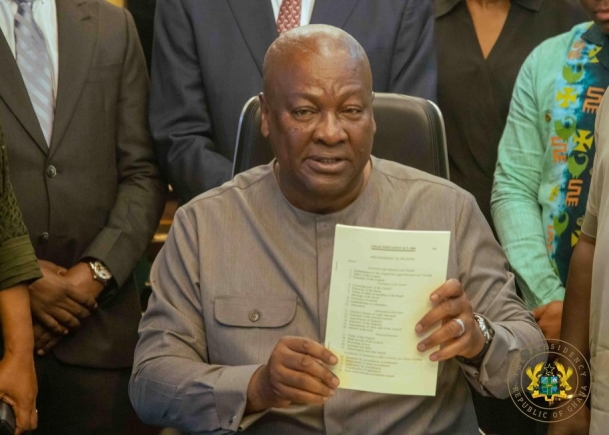
Speaking in Accra last Wednesday, the President assured that “by 2027, there should be no secondary school implementing a double track system in Ghana.”
President John Dramani Mahama said the STARR-J project would support the government’s efforts to eliminate the double-track system in secondary schools by next year.
According to him, the initiative was structured to enhance educational infrastructure, raise standards and increase access to secondary education nationwide.
“This strategic investment is not simply about expanding infrastructure; it is fundamentally about promoting equity, improving quality and widening opportunities for every Ghanaian child,” President Mahama stressed.
Community day schools
The funding will also support the revival and implementation of the community day school initiative through the construction of new E-block facilities in urban and peri-urban areas.
Explaining the plan, President John Dramani Mahama said, “These are going to be community day schools but they are going to be built in urban communities where it will be easy for the children to commute to school and back.”
He further noted, “What this means is that if we get some of the children to go to school within their communities, it will ease the pressure on the boarding schools that are elsewhere.”
President John Dramani Mahama expressed confidence that the policy would help ease congestion at boarding facilities in senior high schools.
“By 2027 there should be no secondary school implementing a double track system in Ghana.”
He further stated that abolishing the system would enhance teaching and learning by allowing teachers more time to prepare effectively for lessons.
Teachers benefit
President John Dramani Mahama also disclosed that the programme would provide ongoing professional training for teachers to strengthen their modern instructional methods and digital skills.
President John Dramani Mahama further indicated that all secondary school teachers would undergo continuous professional development programmes focused on digital literacy and the integration of artificial intelligence.
Addressing teacher career progression, President John Dramani Mahama said promotions to higher ranks would no longer be tied to the availability of administrative roles.
resident John Dramani Mahama said, “Teachers can now progress on merit, competence, experience, performance, and years of dedicated service.”
Double Track System
The double-track system was introduced as a direct response to the Free Senior High School (Free SHS) policy, which began in September 2017. After the policy was rolled out, enrolment in public senior high schools rose by over 30%, creating serious pressure on existing infrastructure such as classrooms, dormitories, and other facilities. To prevent the exclusion of eligible students and maintain teaching standards, the government under President Nana Akufo-Addo introduced the double-track system as an interim solution.
The system officially began on Tuesday, September 11, 2018, for the 2018/2019 academic year and initially covered 400 of the 696 public SHSs. It was introduced under the then Minister of Education, Dr Matthew Opoku Prempeh, who explained that it would help schools accommodate the increased student population while longer-term infrastructure projects were underway.
Under this arrangement, students were split into two groups, originally called the Green Track and the Gold Track. While one group attended school for instruction, the other was on break. The two groups alternated in roughly three-month cycles, effectively operating the academic calendar in shifts.
Challenges
Although it expanded access to education, stakeholders in the education sector raised concerns about the extended periods students spent at home, which they feared exposed young people to social vices.
Parents, teacher unions, and opposition politicians also criticised the system, arguing that it disrupted family routines, compressed the curriculum, and placed additional pressure on both students and teachers, creating new challenges within the education system.
Mahama’s dedication
Pointing to the adverse effects on students, teachers, and parents, the government has also set aside GH¢1 billion from the Ghana Education Trust Fund (GETFund) to finish unfinished infrastructure projects in the impacted schools.
The stated objective is to completely abolish the double-track system by 2027 and restore all senior high schools to a single-track structure with a continuous, year-round academic calendar.