
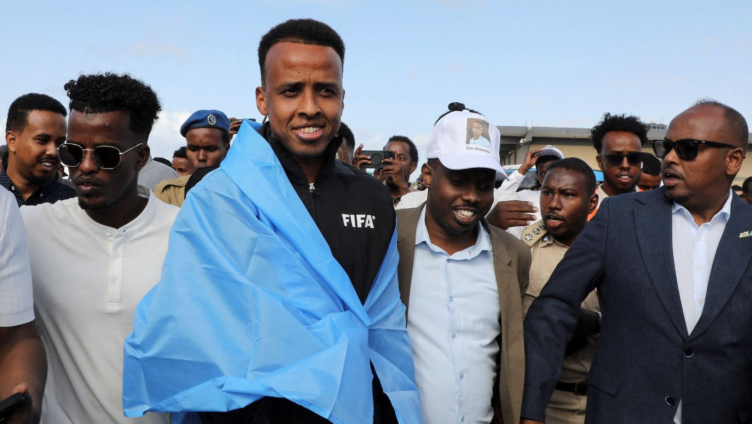
Somali referee Omar Artan was denied entry into the United States over allegations of links to suspected terrorist associates, according to a US official. The 34-year-old, who was named Africa’s Referee of the Year in 2025, had been poised to become the first Somali official to referee at a FIFA World Cup finals. However, he was turned away at Miami International Airport on Monday despite travelling with a diplomatic passport and a valid single-entry US visa. Somalia is among the 12 nations currently subject to a US travel ban introduced by President Donald Trump.
Artan returned to Somalia on Wednesday.
A source within the Trump administration said, “This individual was seeking admission to the United States. Upon further inspection by CBP [Customs and Border Protection], derogatory information, including associations with suspected members of terrorist organisations, was discovered, rendering the traveller ineligible for admission to the United States under the Immigration and Nationality Act (INA). “The traveller was refused admission and given immigration forms that provide the section of law used to complete an expedited removal under 8235 of the INA.
“President Trump’s administration will not allow any security threat to enter our country – full stop.”
BBC Sport contacted Artan for his response. Speaking to The New York Times on Tuesday, he said US border officials questioned him about alleged ties to the Somali militant group Al Shabab, claims he denied any knowledge of.
Upon his arrival at Aden Adde International Airport in Mogadishu, Artan received a warm welcome from government representatives, officials of the Somali Football Federation, fellow referees and residents. He later met Somali President Hassan Sheikh Mohamud at the Presidential Palace. He was also scheduled to attend a public gathering at Mogadishu Stadium and watch a league fixture between Heegan and Dekadaha later that day.
Addressing the media briefly at the airport, Artan reiterated his ambition to officiate at the 2030 World Cup but declined to answer questions.
“I’d like to thank the officials, ministers, MPs and everyone. I want to thank my country and people for their support. The encouragement I received here, I know I’ll get more support outside [the airport],”
“Everything is pre-destined. FIFA supported me well and were in touch with me until I reached Mogadishu. “I promise you that I’ll be officiating for you in the next World Cup. Somalia, everywhere, I’m letting you know.”
Artan, one of 52 referees selected for the World Cup and the Confederation of African Football’s Men’s Referee of the Year for 2025, saw his hopes of participating in the tournament dashed when he attempted to travel to Florida, where all match officials were required to be based. He told The New York Times that he underwent an 11-hour immigration interview, was held for several hours, and was eventually placed on a flight to Istanbul, Turkey.
Speaking to BBC World Service, Andrew Giuliani, head of the White House Task Force on the World Cup, defended the decision.
“While I can’t go into the derog [derogatory information] on that I can tell you it was the right decision by customs and border patrol and I support that decision.”
Officials explained that referees could not be stationed outside the United States to work matches in Canada or Mexico, as all on-pitch officials were required to train, prepare and remain under security arrangements in Florida.
In June 2025, President Trump imposed a comprehensive travel ban covering all visa categories for citizens of 12 countries, including Somalia. Months later, ahead of the World Cup draw, he drew criticism for remarks about Somalia while discussing a planned immigration operation in Minnesota, home to a significant Somali population.
“With Somalia, which is barely a country, you know, they have no anything,”
“They just run around killing each other. There’s no structure.”
Trump also stated that Somali immigrants should “go back to where they came from” and that the United States would “go the wrong way if we keep taking in garbage to our country”.
After returning home, Artan encouraged young Somalis not to lose faith in their nation despite his experience.
“Let’s all defend Somalia’s honour. We all belong to Somalia, whether it’s bad or good.
“That flag is ours and so is the passport – let’s defend it.”